
Interesting Info -> Lying Index -> How to Detect Lies
How to Detect Lies
Become a Human Lie Detector (Part 1)
Warning: sometimes ignorance is bliss. After gaining this knowledge, you may be hurt when it is obvious that someone is lying to you. The following deception detection techniques are used by police, forensic psychologists, security experts and other investigators.
Introduction to Detecting Lies:
This knowledge is also useful for managers, employers, and for anyone to use in everyday situations where telling the truth from a lie can help prevent you from being a victim of fraud/scams and other deceptions.
This is just a basic run down of physical (body language) gestures and verbal cues that may indicate someone is being untruthful. Remember: these signs don’t indicate someone is lying, just that they are more likely to be lying.
If you got here from somewhere else, be sure to check out our Lie Detection index page for more info including new research in the field of forensic psychology. Last update: April 10th, 2013.
Signs of Deception:
Body Language of Lies:
• Physical expression will be limited and stiff, with few arm and hand movements. Hand, arm and leg movement are toward their own body the liar takes up less space.
• A person who is lying to you will avoid making eye contact.
• Hands touching their face, throat & mouth. Touching or scratching the nose or behind their ear. Not likely to touch his chest/heart with an open hand.
Emotional Gestures & Contradiction
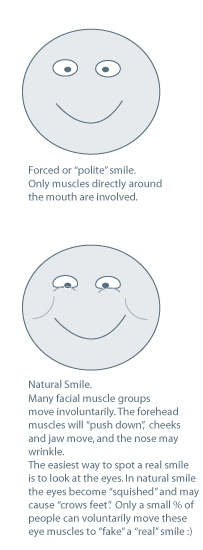
• Timing and duration of emotional gestures and emotions are off a normal pace. The display of emotion is delayed, stays longer it would naturally, then stops suddenly.
• Timing is off between emotions gestures/expressions and words. Example: Someone says “I love it!” when receiving a gift, and then smile after making that statement, rather then at the same time the statement is made.
• Gestures/expressions don’t match the verbal statement, such as frowning when saying “I love you.”
• Expressions are limited to mouth movements when someone is faking emotions (like happy, surprised, sad, awe, )instead of the whole face. For example; when someone smiles naturally their whole face is involved: jaw/cheek movement, eyes and forehead push down, etc.
Also see our article on micro expressions & lying.
Interactions and Reactions
• A guilty person gets defensive. An innocent person will often go on the offensive.
• A liar is uncomfortable facing his questioner/accuser and may turn his head or body away.
• A liar might unconsciously place objects (book, coffee cup, etc.) between themselves and you.
Verbal Context and Content
• A liar will use your words to make answer a question. When asked, “Did you eat the last cookie?” The liar answers, “No, I did not eat the last cookie.”
•A statement with a contraction is more likely to be truthful: “ I didn’t do it” instead of “I did not do it”
• Liars sometimes avoid “lying” by not making direct statements. They imply answers instead of denying something directly.
• The guilty person may speak more than natural, adding unnecessary details to convince you… they are not comfortable with silence or pauses in the conversation. • A liar may leave out pronouns and speak in a monotonous tone. When a truthful statement is made the pronoun is emphasized as much or more than the rest of the words in a statement.
• Words may be garbled and spoken softly, and syntax and grammar may be off. In other words, his sentences will likely be muddled rather than emphasized.
• The use of distancing language. 
Also see our article on Statement Analysis for a more in-depth look at word analysis techniques used by interrogators.
Other signs of a lie:
• If you believe someone is lying, then change subject of a conversation quickly, a liar follows along willingly and becomes more relaxed. The guilty wants the subject changed; an innocent person may be confused by the sudden change in topics and will want to back to the previous subject.
• Using humor or sarcasm to avoid a subject.
Final Notes:
Obviously, just because someone exhibits one or more of these signs does not make them a liar. The above behaviors should be compared to a persons base (normal) behavior whenever possible.
Most lie detecting experts agree that a combination of body language and other cues must be used to make an educated guess on whether someone is telling the truth or a lie.
 Continue Reading Part 2 – Eye Direction & Lies Continue Reading:

Eye Movement and Lying (Lie Detection Part 2) How to tell if someone is lying based on the movements of their eyes. Read the research behind this theory of eye direction and what it can reveal about our inner state of mind.

Lying Resources, Books & Links (Lie Detection Index Page) Index to all of our lying resource pages, along with additional links, research, videos and books. Start here if you are new to this site. New: Why Do People Lie?
More How To Guides | Interesting Info Home Page | More Blifaloo!
Comments on Detecting Lies
User Comment Archive: Page 1 | 2 | 3
Recommended Reading & Related Products:
You may also want to check out my lying index page for many more book recommendations.
Puzzle3: It is double pleasure to deceive the deceiver. – Niccolo _____________
Interesting Info -> Lying Index -> How to Detect Lies
About – – Search – Blog – For Webmasters
Blifaloo.com is temporary boredom relief & knowledge for the curious mind
Copyright 2004 – 2026 | blifaloo.com